The Democratization of Investment Research: Navigating the Shift from Sell-Side to Social
Opinions
Aug 17, 2025
Once upon a time, equity research was one of the best paying jobs in finance. $10M+ pay was possible in the 1990s, I was told when I was on an externship with Morgan Stanley equity research team in NYC back in early 2000s. Things have really changed. We believe we are likely in the middle of the democratization of research, from centralized sell-side pools to social and DIY.
Decline of Sell-side Research
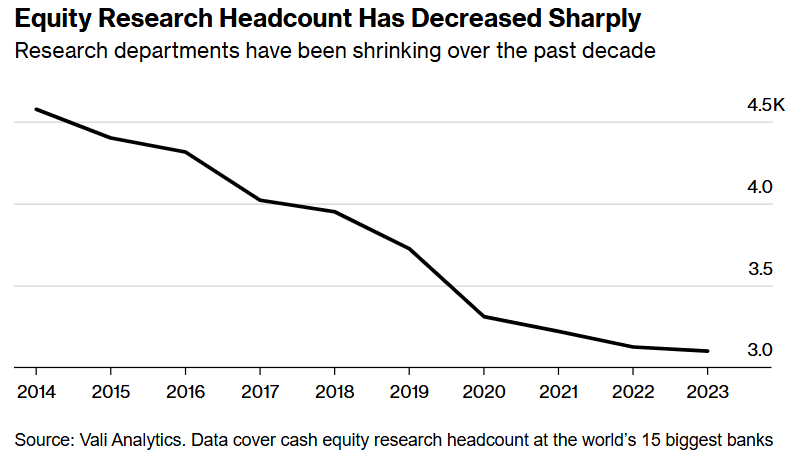
According to a recent Bloomberg article, starting salary for sell-side research analysts stands at $110-170K, stagnant for many years. The job cuts have also brought down the total number of analysts to now only 3K globally. As a result, the coverage has been shrinking and the quality likely has been declining too, just given how thinly spread each analyst has to become.
So not surprisingly, when we asked our users how important sell-side research is to them, I got a very interesting mix of answers. One friend running his fund focusing on small / mid cap companies never uses sell-side research, because most of his targets are not covered - for reference, Morgan Stanley globally only covers about a bit over 3K stocks. Some others believe corporate access and / or getting a feel about what other investors care about are primary benefits from the interactions with sell-side research, not the reports or views. I personally know many brilliant analysts, including some of our advisors. However, the reality seems to point to an inevitable direction - the industry is undergoing a permanent change. Matt Levine had a recent Opinion piece on this topic, and we largely agree on the dynamics behind this.
Emergence of Social Research
When we asked our users what interesting reports did you see recently, we now hear podcasts, substacks and newsletters from peers. It seems to us everyone listens to “Acquired” by Ben Gilbert and David Rosenthal. So we set off also to understand the emerging landscape of these alternative research resources.
There are currently mainly five media / platforms:
Podcasts & Youtube channels: the highest quality ones based on our opinion. There are roughly 4 types:
Deep dive into a company: Good hosts usually spend a significant amount of time conducting proprietary research, resulting in high quality content.
Interviews with top investors: for example, BG2 by Bill Gurley and Brad Gerstner, had great discussions with investors such as the Laffont brothers at Coatue. While Bloomberg and CNBC also invite investors onto shows to provide comments, these interviews are of lengthier and meatier, packed with thought-providing ideas.
Primers on a new theme or trend: we often found some of these well-made videos explain industry dynamics and tech trends with much clearer narratives. While very often not deep enough, as the content caters to a wider audience, these serve as good starting points to identify opportunities and key diligence points.
Substack newsletters: according to media reports, tens of thousands of finance blogs live on Substack. We are loyal fans of a few, ranging from macro to sector analysts. Quality varies by author, but you can find the top ones on par with sell-side level, sometimes with sharper narratives. However, the median level, based on what we see, is below what good sell-side analysts could share when they talk to you offline. While astonished by the price tag and the amount of revenue some substack bloggers can make, this is probably nothing new - high quality research should be worth a lot. I enjoyed very much reading 13D by the industry veteran, Kiril Sokoloff.
X accounts: many accounts focus on pitches. I do occasionally find interesting stocks from some accounts specialized in different niches (e.g. Japan stocks). However, many are catered to short-term retail traders, e.g. pushing buy / sell recommendations based on charts.
AI / UGC research articles: Seeking Alpha, Benzinga, Stock Story… and more and more services generate articles at scale. While some audience may find these helpful, likely many serious investors will find them not so helpful, just like this reddit post.
Independent research networks: this is a new form and an experiment that we started seeing recently. A few researchers who are ex analysts form an alliance to combine their research expertise, contribute and market their content together. They are professional, go in depth to conduct proprietary diligence including expert calls, and they usually have skin in the game for their own published research (the research targets are usually what they want to buy / sell themselves).
We think the democratization of research is likely to continue. While Tik Tok started with silly sing along and dance shorts, now the best contents there are professional-grade and can beat many premium content. Similar change may happen, as we see more professional investors among our users allocate their reading time towards substack and podcasts. We ourselves actually get macro views from a substack newsletter not Bloomberg or Reuters.
Sell side research function won’t disappear, because corporate access is still highly valuable, and it is an integral function of the investment banking business. However, we think we will likely see more differentiated opinions and depth coming from social research channels, as some of the best talents and the power of the crowd will shine there.
Implications
Proliferation and democratization will mean fragmentation and higher demand for investors’ time. “I spent the morning reading all these substack articles. Some of them are very interesting. But then, in the afternoon, I wonder what exactly I got out of them. But then, I don’t want to miss anything interesting, so I am still drawn to them in case….” This is from one of our users. And it is probably representative of the mentality. Substack newsletters and podcasts have one structural disadvantage vs. sell-side research papers - they are not systematic. There is no obligation or routine for the bloggers or hosts to keep analyzing the same company at a fixed frequency. Their content don’t even need to stay within the same domain. So this means investors in the future will have a significantly larger amount of content of varying quality or relevance to digest, if they want to take advantage of the social research content. This adds more to the #1 problem faced by professional investors - info overload.
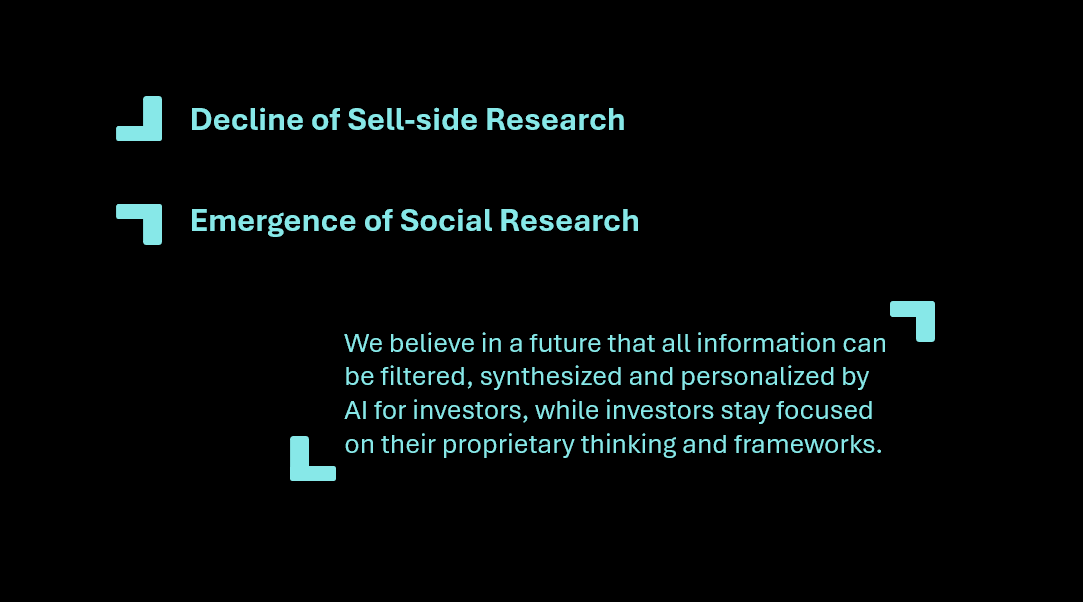
We believe in a future that all information can be filtered, synthesized and personalized by AI for investors, while investors stay focused on their proprietary thinking and frameworks. We at Distilla are in the first phase of building towards that future, including harnessing AI to surface only the highest quality important insights.
If you are a substack author or podcast host interested in what we do, please drop us a note. We are more than happy to bounce ideas and look for ways to collaborate.
About Distilla
Distilla is an AI-powered insight generation engine, made by veteran investors, for serious fundamental investors. Designed as a full-cycle acceleration platform, Distilla’s agents and AI contents help make investors more efficient in ideation, initiation, analyses, thesis iteration and tracking. Powered by a proprietary knowledge base and analytical frameworks codified from the best investors, Distilla delivers higher quality outputs and better insights. Get in touch with us at info@distilla.ai.