10 Interesting Things We Learnt on Asia Stock Markets
Opinions
Aug 24, 2025
NYSE and Nasdaq have largely dominated the global equity investment scene. And investors should rightfully overweigh on US equities - more dynamic vs. other developed economies and much less risks associated with political and monetary issues compared to emerging markets. But after COVID, Asia is coming back, and some argue that the US increasingly looks like an emerging market.
From a capital allocation perspective, Asian markets represent a deep and wide pool of opportunities for diversification and alpha generation. If we use market cap as a proxy measure, The top equity markets outside the US are all in Asia - China onshore markets ($12T+ in market cap). Japan ($7T) and Hong Kong ($6T), and India (BSE and NSE combined at $5T). If we add in the smaller markets (e.g. Korea and Taiwan, with $2T each), Asia markets combined are getting close to the size of Nasdaq ($30T market cap), with much higher diversification. Just for comparison, Europe’s two largest exchange groups, LSE and Euronext, have $5-6T market cap each, similar to Hong Kong.
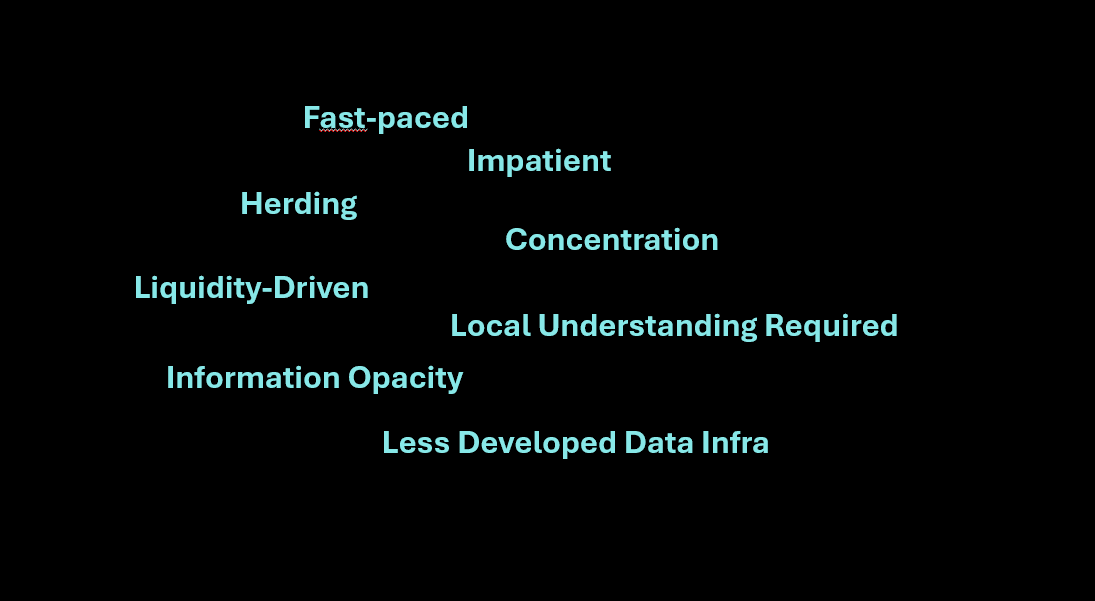
While we develop Distilla and decide on our initial coverage, we have had various conversations with our professional investor users to understand the characteristics of different markets. Below are 10 interesting high-level takeaways:
China onshare A-share markets have distinct characteristics vs. western market: (1) info travels faster and the market is arguably more efficient. While in the US and other markets, quarterly earnings are the primary info cycles, brokers and investors conduct offline conversations, daily/weekly data tracking and field trips much more frequently. This is a result of both capacity (a lot more hardworking and talented Chinese working in finance for a lot more hours), and culture (short-term info-based trades are what most are after. More on this shortly); (2) theme-based herding is more prevalent. The sector boom and bust usually follows policy > theme > top fund moving in > other funds & retail investors pushing up > top funds rotating out > valuation normalizes. So a lot of time is devoted to tracking what other funds, esp big ones, are looking at and fund flows. (3) higher volatility and less patient capital. When a new policy, theme or sentiment triggers a run up or price drop, partially because of herding, the price usually peak or bottom out in a few days, instead of weeks. And because of the well known China speed (speed of policy change, industry cycles and race-to-zero cut throat competitive business environment), onshore investors rotate their positions fairly often, believing less in long-term predictability and sustainability of business champions. All of these mean western investors must adapt a different hi t approach when investing in onshore equities, adapting to the unique info ecosystem and the collective rules of the game.
HK stock market is highly sensitive to liquidity (increasingly the flow from mainland): I was in a meeting a few months ago with a top executive of HKEX, and he pointed out that HK stock market is uniquely different from NYSE, TSE and SHSE, because Hong Kong population of 7 million cannot support the liquidity and HKEX largely depends on “tourism money”, the allocation from China mainland and the western capital. This is why when US funds moved away during COVID, Hong Kong market’s liquidity and HSI valuation dropped to unthinkable levels (8x PE at one point in 2022). Even today, the conversation around valuation rerating still often leads back to when the long-only allocation will recover back to pre COVID level. With western allocation to HK still gradually recovering, the onshore flow to HK market has soared back. Now onshore capital represents close to half of the $0.6T monthly turnover. This has made Hong Kong market, which traditionally behaved more similar to western markets, move closer to onshore a-share market characteristics. However, large cap companies remain highly influenced by western funds, as they tend to be the natural targets for index-level weight adjustments.
Chaebols dominate the Korean market, requiring local understanding: in my career, I spent 2 years closely looking at Korean companies. Some of our good friends are also Korean and are veterans in covering the Korean market. it is a fascinating market with great new and old operators, such as the top K-pop and K-drama studios, the Amazon of Korea - Coupang, and many world leading gaming companies. However, it remains a distinct market that requires local connections and deep understanding. (1) top 10 chaebols account for half of market cap, and the unique family and business-political dynamics are well known to insiders but likely hard to decipher for foreign investors. For example, stock prices tend to be artificially suppressed to help with succession related taxes when one generation of family heads pass on their power and shares. And the interconnections and rivalry among different companies very often cause “unexpected” turmoils. This doesn’t mean foreign investors cannot do well investing in Korea. We know a few that have had great track records. However, the limited coverage in English and the intricate country-specific dynamics warrant careful diligence.
Taiwan market important for semi / tech, but with limited public info disclosure: not unlike Korea, Taiwan businesses tend to be also relatively thinly covered by public media. Public disclosures tend to be sparse and on-the-surface. If you really want to understand a business, you have to “go karaoke and clubbing with the management”, as described by one of our friends. But given the importance of Taiwan companies within the semi, industrial and electronics supply chain, the company's performance can shed light on important business aspects for companies listed elsewhere.
The Indian market has a great macro story, but company fundamentals are difficult to analyze: the views and experience on India stock market have been very polarizing. One investor we highly respect opened up a shop focusing on India a few years ago and achieved stellar performance, and he still has a very bullish view on the tailwinds and potential of this most-populous country in the world. At the same time, I have looked at tens of companies closely and found it very difficult to have high conviction when evaluating businesses bottom up. And it turned out that a few of these actually failed to live up to the hype or proved to be fraud. A few of our investor friends who have spent significant time on the ground also share this view - governance, lack of reliable diligence access and red-tape / anti-trust practices make the market very different, maybe like the China market in 1990s. There are great operators and conglomerates, and India has a wonderful macro story, but for stock pickers going deep in fundamentals, it represents a unique set of challenges.
Japan has been and will likely be a great hunting ground for fundamental investors: probably because Japan has opted for more conservatism learning from its volatile go-go day boom and bust, or probably because Japan’s stable yet slower society, the Japan market has been largely fundamental driven, yet undercovered, over the last decade, thus making it an attractive operating space for stock pickers. In recent years, Japan has been revitalized and starts to see more tailwinds, including the focus on governance improvements, shareholders return and most importantly, the normalization shift from deflation to inflation. It’s no wonder that Warren Buffett bought into his Japanese positions and said he planned to hold them for 50 years. Some investors describe Japan market as traditional and slow - you still see stock price jump or slump at earnings surprises (opposite to the high info efficiency in China) and paper newspapers are still read by investors. But that is the beauty of Japan market - if you are diligent and disciplined, you can find hidden gems and long-term growers at reasonable valuations.
Vietnam, Thailand, Indonesia and Singapore markets are still relatively shallow: these are all sub-trillion markets. One example is Vietnam - while the economy has benefited tremendously from China + 1, there are limited equity proxies for investors - the top listed companies are largely state-owned banks. While Singapore has an interesting mix of mid / small cap companies from the broader Asia region, most are small and cannot meet the liquidity bar for larger hedge funds.
Information infra and ecosystem for Asia markets lag behind US / western peers: US is a leader in corporate info access - filings and XBRL files are readily digestible for any one in real time and earnings transcripts are pretty much freely available to the public. On the other hand, most of the financial data vendors that focus on transcripts (e.g. FMP, Finnhub, Quartr) claim to have global coverage but have very sparse coverage on companies listed in Asia. This is due to (1) lack of consistent reporting (e.g. Japanese companies do not all conduct earnings call in English), (2) relatively looser regulations / legacy infra on the exchange side on reporting (e.g. HKEX allows A/H-dial listed companies to just disclose the earnings events, if the earnings calls are hosted elsewhere onshore) and (3) general US-centric mentality of most fin data companies. The result is a considerably weaker and less modern data infra & ecosystem. For example, Edgar-like filings APIs are not freely available for either Tokyo or Hong Kong stock exchanges, and even for the few vendors that organize filings on Japan-listed companies, only English filings are available while more companies file in Japanese with a lot more info in the Japanese version. The exception is China onshore markets, which has a unique and yet very efficient info infra & ecosystem.
Info asymmetry still exists and can lead to alpha: fewer and smaller investors focus on Asia markets relative to the US, and many Asian investors still are able to find good alpha (may or may not be sustainable) from info asymmetry. For example, one investor did a successful bet on a Korean retailer that serves many Chinese tourists when he noticed reports from Chinese media on the change in shopping pattern. The change was not picked up by other analysts or Korean media, and resulted in a big earnings surprise. More recently, on the CK Panama port deal, a harsh letter from a Chinese gov agency in HK criticizing Li Ka-Shing and CK was ignored for many days, until noticed and surfaced by some in the investment community, quickly triggering a revelation that the deal may not go smoothly. Macau’s casinos saw a big jump in share price a few weeks ago, but was a delayed response to the rise in foot traffic linked to increased high-profile concerts. The important and relevant information is out there in public, and when identified can lead to alpha in Asia.
Fundamental approach sometimes backfires, but works well if patient and disciplined: during Hong Kong market’s rapid upward rerating and market surge in 2H24 / 1H25, many hedge funds in Asia were caught off guard. Many fundamentally strong companies went up, but not as much as the more speculative less profitable names. Some saw negative returns as the companies shorted turned out to have higher beta and went up a lot more than the good companies in the long positions. Some high quality and high cash flow companies also can underperform for a long time, due to coverage or liquidity issues, while the herding mentality could push some hot company far beyond reasonable multiples. This is not uncommon in the US either, but things tend to be a little more extreme in China, if you look back at the history of A-share valuation peak levels. Another common pessimistic view on Asia markets is around the higher amount of unpredictable factors - industries are more regulated with state-owned enterprises or big business conglomerates or influential families exerting outsized influence. Fundamental investing bets that good things will continue happen to good companies, but good companies may face life-of-death political / regulatory / geopolitical challenges over night (e.g. TAL in China, Kakao in Korea, etc.) Some take the approach that they;d rather operate in a more mature market with more controlled uncertainty outside pure business elements, but this largely means staying away from all developing countries. But others, some great investors we know in Asia, adopt a very disciplined risk management approach and patient stance believing in fundamentals. Many have been rewarded handsomely throughout the cycles.
Overall, the Asia market represents a significant pool of diverse opportunities equal to the size of Nasdaq or NYSE, while presenting both unique challenges (info access, local characteristics, and non-business uncertainties) and plenty alpha opportunities. To enable investors to win in this market, esp in the age of AI, systems that can process and surface high quality info tailored for Asian markets are needed.
From day one, our founding team at Distilla have had extensive investment experience in both Asia and US markets, and set off with a global mindset. Instead of pursuing the easy path of assembling a solution fast for US market only, we did a lot more hard work to work with the local info system. Just to name a few examples below:
creating pipelines to ingest filings in Japanese for Japan-listed companies
tuning our LLM processing pipeline to work well with news articles and documents in Chinese, Japanese and Korean (e.g. this unique negative symbol in Japanese documents)
adjusting to different reporting frequency and scope (Japanese companies report financials on cumulative quarters such as first 9 months, instead of a single quarter, while HK companies are only required to report semi-annually), etc.
working closely with our financial news vendor to correctly tag and organize articles for numerous Asia-listed companies (e.g. one of the hottest HK stocks, Laopu Gold, was not tagged or tracked originally by our US-based vendor, not surprising as not many startups build systems with Asia markets in mind!)
Through countless hours of tedious manual work, we aim to deliver better quality to our users looking into Asia markets. We know you are rigorous, serious about your research and a little bit of efficiency & accuracy gain can go a long way.
If you are learning and investing in Asia markets, or interested in what we do, drop us a note any time. Our beta trial is invite-only, free and on-going. Let us know if you are interested in a demo, and we are more than happy to respond and jump on a call within 12 hours.
About Distilla
Distilla is an AI-powered insight generation engine, made by veteran investors, for serious fundamental investors. Designed as a full-cycle acceleration platform, Distilla’s agents and AI contents help make investors more efficient in ideation, initiation, analyses, thesis iteration and tracking. Powered by a proprietary knowledge base and analytical frameworks codified from the best investors, Distilla delivers higher quality outputs and better insights. Get in touch with us at info@distilla.ai.