From Efficiency to Alpha: The 3 Stages of AI Adoption in Hedge Funds
Opinions
Aug 10, 2025
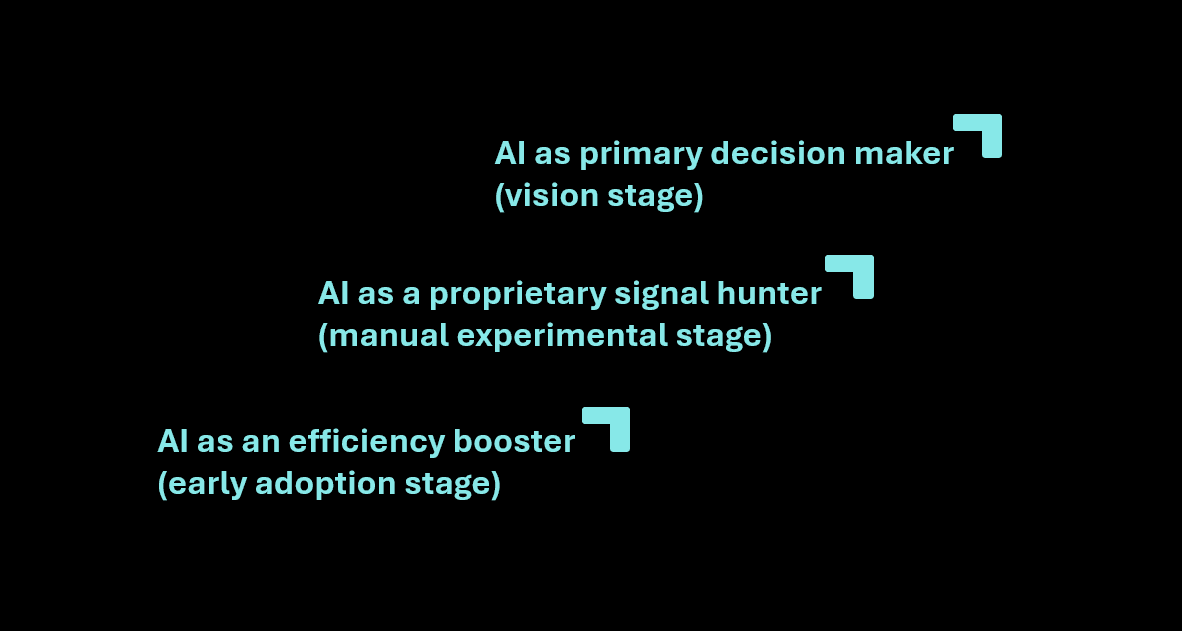
In mid-2024, before we started our journey, many believed that the finance industry would again be a late adopter of genAI. Today, the conversations have shifted from if to how. Below are a few developments and our take on directions discussed with our friends, and we are sharing them here.
AI as an efficiency booster (early adoption stage)
These are the low-hanging fruits, with on-going adoption. Below is our summary of the current stage of AI efficiency use cases in investing.
Transcribing Calls & Organizing Notes (solved)
Use Cases: Earnings, expert calls, offline meetings
Adoption: Wide adoption of general tools (Fireflies / Otter) or embedded services (Zoom, Google Meet, Tencent Meet). This is largely solved and commoditized
Industry Analyses (mostly solved)
Use Cases: Initial learning on a new industry
Adoption: OpenAI & Gemini’s Deep Research are effective in helping consultants at Bain and others. The reports are generally good enough for “Internet-average” intro-level synthesis, but lacking depth and often filled with errors or outdated info.
Info Lookup & Synthesis (being solved)
Use Cases: Search & synthesize filings, transcripts and other documents
Adoption: Among legacy players, only AlphaSense has enabled this for some use cases on top of its existing doc search infrastructure; ChatGPT, Perplexity or Claude is largely unusable, due to reliance on web search and lack of integration of IR documents & corporate news.
Distilla Approach: Current solutions can be inaccurate, biased, or incomplete. To solve this, our approach at Distilla involves pre-processing information from comprehensive sources into an internal knowledge base, ensuring higher quality answers.
Agentic Analyses (being solved)
Use Cases: Benchmarking, data collection & quantitative tasks, identifying patterns
Adoption: No legacy or horizontal players satisfy this well today. Claude is starting to enable this with its recently-launched solution leveraging MCP integration with legacy vendors for financial data.
Distilla Approach: A good vertical agentic system requires both integration with high-quality knowledge base and domain knowhow. We have built a leading investor solution designed with those two goals. Multi-agent systems started in Q2 2025, and we are on our way to evolve with the tech ecosystem and our users.
Routine Analysis Automation (being solved)
Use Cases: Company primers, comps, technical analyses, price move drivers, etc.
Adoption: Limited AI upgrade by legacy systems (still dashboard of numbers), and not a focus by ChatGPT, etc. We heard that some podshops (think Millennium / Citadel) are building internal systems to help their analysts with identifying historical price move drivers.
Distilla Approach: using AI to conduct routine insight tasks is the core focus of Distilla. We have handcrafted flows to offer the best AI generated primers, technical read, price move explanations and key drivers, all common and important tasks during initiation and tracking. We are in the process of building more professional-grade insight modules in the months to come.
Screening (not yet solved)
Use Cases: Identifying companies based on themes, metrics, profiles or developments
Adoption: Limited AI upgrade by legacy systems (still metrics-based); ChatGPT / Perplexity and some vertical startups have partial solutions (e.g. thinking + web search); Some hedge fund platforms internally experimented on this.
Challenges: To answer a screening question such as “what are the 2nd derivative beneficiary from Trump’s potential tariffs on Pharma” will require both comprehensive knowledge and causal understanding. This remains an open problem..
Excel Modeling (not yet solved)
Use Cases: Building and updating models
Adoption: While some vertical startups aim at improving in-excel efficiency, the use case is not yet fully solved. We also see horizontal players, such as Microsoft, Google and other excel-focused agentic system startups pushing the boundary daily, giving us hope that the tech & tools will be in place in the mid-term future.
Challenges: Our users want robust and dynamic modeling assistance that incorporates the right drivers and assumptions, which is not yet well satisfied by the current state of development. But we believe it is a matter of time.
Portfolio mgmt & back-office ops (not yet solved)
Use Cases: Risk management, compliance, reporting, trading, accounting, and audit
Adoption: Early stage in AI upgrade or adoption. We expect to see more vendors upgrading their solutions, with AI native products coming to market as well.
AI as a proprietary signal hunter (manual experimental stage)
One of the top questions we got from our users is: can your AI give me ready-to-trade ideas?
To a certain degree, yes, there are a few early attempts.
One example was the Australian startup fund’s adoption of AI to identify inflection points. They ingest daily articles and let LLM process them to synthesize and rank. In addition, we have also heard other experimental approaches to use LLMs to derive signals, including:
Detecting tone or sentiment changes from news or earnings calls
Detecting potential risks of accounting fraud from earnings
Scraping Reddit or other online sources for signals on customer adoptions (SaaS or consumer / retail brands)
We believe leveraging AI to identify signals will be a table stake for the fundamental investing industry, just like using excel to crunch numbers today. However, these types of LLM-identified signals have quite a few limitations in our mind:
(1) unproven nature - assessing the hit rate of these signals tends to be harder for fundamental investing, given a longer horizon (and the associated noise & unpredictability). Quant (and LLM training) benefits from simple yes/no testing, but fundamental investing is fuzzy, and hard to isolate factors given a longer horizon - if anyone says AI can give you 50%+ accuracy in predicting returns consistently, it’s likely a fraud.
(2) these signals may lose their reliability or alpha over time - there is likely a reactive attempt to game the LLM for signals from the corporate side, such as IR / PR teams purposefully crafting positive messaging, discussed by WSJ.
However, we believe AI can effectively generate candidate ideas for investors to consider based on their own frameworks, domain expertise and intuitions. Today, there are many “high-conviction” calls from sell-side banks, KOLs and experts. There are also many alternative data vendors. These have varying degrees of predictive power, yet still valuable to investors. So will be signals and insights identified by AI.
AI as primary decision maker (mainly in quant, vision stage for fundamental investors)
The most prominent example is Bridgewater’s launch of its $2B AI fund and the confirmed performance recently. CEO Nir Bar Dea recently stated that the fund is generating "unique alpha that is uncorrelated to what our humans do" and delivering returns that are "comparable" to the firm's traditional human-led strategies. The AI, focused on understanding causal relationships in markets, generates the investment ideas. Human professionals then oversee critical functions like risk management, data acquisition, and trade execution. This shift is also reshaping Bridgewater's talent strategy; the firm is moving away from hiring purely for analytical and financial skills and is now seeking conceptual thinkers who can "ask philosophical questions" and perform the high-level reasoning that machines cannot yet replicate. Bridgewater on Playbook Change
We are primarily hearing quant / macro funds moving in this direction, as the move from using small models to LLMs (and gradually to iterative agents) to generate and blend signals has been a natural extension. The bar for using LLMs to run a concentrated and longer-horizon fundamental L/S fund is much much higher. But we see a natural projection of higher adoption of AI for assisted decision making from quant to quantamental and eventually to the fundamental investing world.
Overall, we are firm believers that we are only at the 1st step of upgrading our investment industry with AI. We saw investment practice, ecosystem and landscape dramatically shifted during the last two tech waves - democratization of investing via Robinhood & KOL / gurus (PC / mobile / Internet), rise of quant (PC / Internet), proliferation of data vendors & aggregators such as Bloomberg and CapIQ (PC / Internet). We expect more interesting and significant changes to come in the next few years. Here at Distilla, we are rooting for all serious fundamental investors and want to be the enabler and partner behind the future champions.
Thank you for your time. If you are a serious fundamental investor, get in touch to see how our platform can accelerate your process.
About Distilla
Distilla is an AI-powered insight generation engine, made by veteran investors, for serious fundamental investors. Designed as a full-cycle acceleration platform, Distilla’s agents and AI contents help make investors more efficient in ideation, initiation, analyses, thesis iteration and tracking. Powered by a proprietary knowledge base and analytical frameworks codified from the best investors, Distilla delivers higher quality outputs and better insights. Get in touch with us at info@distilla.ai.