How Fundamental Investing Will Evolve with AI
Opinions
Aug 2, 2025
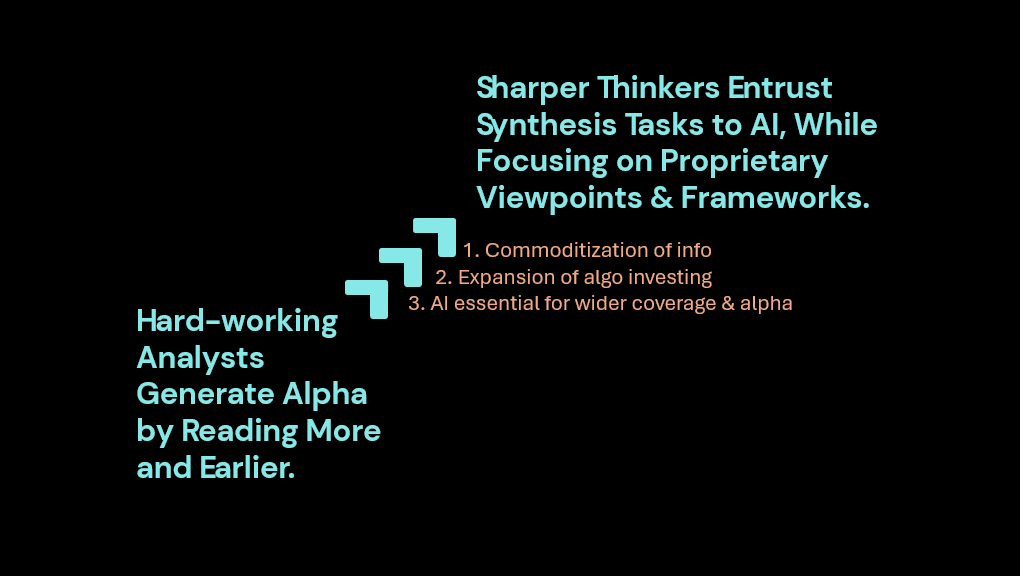
For us and many of our investor friends, the industry has not changed much over the past two decades, the entirety of our career. But if history repeats, this is about to change. Below are some reflections and predictions.
The Last Tech Wave: How the Internet Changed Investing
Before predicting the future, it's crucial to understand the past. The rise of PCs and the internet created today's investment ecosystem from scratch, spawning giants like Bloomberg, S&P, and FactSet, Renaissance, D E Shaw, Two SIgma, Jane Street, Interactive Brokers, Robinhood, and many more. This disruption hinged on three key developments:
Reduced information asymmetry
Back in 1970s and 1980s, some investors were only able to get their hands on the physical copies of corporate earnings weeks or even one month after they were released, with daily close prices usually reported on newspapers with one day delay. This gave the diligent and professional investors in NYC a significant edge in information access. Now, big or small news events are quickly disseminated around the world, with minimal delay and largely equal access.
As a result, it’s been getting harder to generate alpha by just reading filings or newspapers. Professional investors have turned more and more to expert calls, on-site diligence, one-on-ones with management or alternative data to look for that information edge, which now accounts for a big portion of investors’ daily activities.
Rise of quant trading
Brokers shouted and waved physically to get orders matched on the floor of NYSE in the 1980s. Naturally, the spread was big and the volume was low. This inefficiency was the source of a new type of alpha, as soon as the Internet changed the game of electronic trading. Then came the quant funds, esp. high frequency trading, now accounting for about half of US trading volume.
Creation of essential digital infrastructure
Given Bloomberg’s $10B+ annual revenue, it’s probably conservative to estimate that the annual spend on financial analytics, alternative data and research systems is well above $50B. When Warren Buffett and Ray Dalio rose to fame, all they needed were probably a pen, a notebook and their brains. Now, it’s unthinkable for any hedge fund to not have the digital infrastructure. At the beginning, it was more about efficiency - the difference between covering 20 companies by each analyst in the 1980s to now 40-50 stocks per analyst. But, as mentioned above, the diminishing info asymmetry made these tools and data must-haves for alpha generation.
Future
So how will AI change the game? We can hypothesize along the similar dimensions we have seen in the past wave of disruption, as AI is somewhat a step-function extension of the info tech we saw that started 30 years ago.
Commoditization of information and syntheses
Info overload is the #1 problem cited by our users, and this is about to get a lot worse. First, AI is dramatically reducing the cost of content creation, and comes with it both the expansion of info scope and the dramatic rise of “summarism” (I'm using this term to describe the numerous AI summaries).
A concrete example of this commoditization is around diligence calls. Now AI bots can easily join a call, transcribe and organize the notes. So what is happening now? First, FOMO drives investors to dispatch their AI bots to more meetings. Then, because these meeting notes feel cheaper, they get made more available to other investors. In China where the investing game is highly competitive and more focused on info access, we are already seeing democratization of these supposedly private meeting notes - sell-side small group calls, closed doors with management, expert calls, field trip notes and many more are accessible to all investors at a very low price.
So what should investors do in the future? Option A: work harder. But how many articles can you read a day? Can you really sip through thousands of articles better than AI? Option B: curation / filters. You can choose to only read Bloomberg or WSJ, or a few selected and trusted sources. We bet you would feel FOMO and you will miss critical info. Option C: rely on AI. Great, AI created this problem, and we now need to let AI help us solve this.
At Distilla, we came to the conclusion that AI will likely be the primary reader and synthesizer of information, not humans. And AI’s role will be a combination of curation, investigation and summarization - it should sip through info, find the important ones, identify relevant info and present the right briefing to the investors. This of course is very different from the current Q&A model built by ChatGPT, Claude, Perplexity and others. You must know exactly what you look for and initiate that conversation to get the info you want (i.e. “pull”). ChatGPT also cannot “filter, curate and push” to you, because it lacks the financial context, data integrity or in-system knowledge. On the other hand, Distilla ingests, classifies, dedupes and synthesizes news, filings and many more into our system from day one, so that we could build towards that future.
Rise / expansion of algo (AI) trading
In the past, quant trading has been limited to the factors that can be quantified. Now with LLM, almost all qualitative info can also be converted into signals. So it’s natural to project that the domain of algo trading will expand from the sub-second, sub-minute domain to experiment with events and fundamental info more complex or fuzzy than before. What will come about? Maybe it’s a new breed of fundamental investing directed complete by AI, maybe it’s an evolved version of quantamental. Two big challenges we see today for this vision are (a) reproducibility issue - LLM systems can translate the same or similar situation or content into different conclusions each time, even with the same prompt, and this gets worse with longer chain of agentic reasoning, (b) fuzzy framework - operations on numbers are precise, but language is not by nature. However, we do believe a new class of investment strategy and process primarily enabled by genAI will emerge and can become powerful.
AI becoming essential for generating alpha
AI has the potential to break down constraints and barriers in multiple ways. An AI system can “know it all” across thousands of companies, which no individual investor is capable of. An AI agent can also be created and deployed super fast to mine for signals from countless Internet sources. Things like monitoring eCommerce sales data on a new sports brand had to be done by specialized vendors, but now any tech-savvy investor can scrape and mine anything if (s)he wants to. An AI system can know all the history and can also know your particular investment philosophy, making it a perfect thought partner. We are actively experimenting in all these directions, as we index all knowledge on companies inside our system and we have built the v1 Advisor Agent backed by historical lessons, case studies and patterns.
Implications: How to Adapt and Thrive
To adapt to the changes, we see following implications:
Hire thinkers not doers: we used to hire hardworking junior analysts who are detail-oriented and good at collecting data, building models and organizing call notes. As AI takes over many of these tasks, an investor who can perceive what others miss,, come up with the right questions, and constantly learn & update his world views would be much more valuable for the team
Look harder for arbitrage - wider net, deeper conversations or contrarian world views: information asymmetry will be diminished further. It will be highly doubtful that you can outsmart other professional investors or even retail investors on Microsoft’s stock. The hunt for proprietary insights and alpha will likely require a wider universe, in terms of markets and market cap coverage, or a sharpened focus on first-hand observations. Conversations that are not transcribed and field trips that are not reported will have much higher value.
Embrace and leverage AI: this is not about using AI utilities like ChatGPT or sending an AI bot to take notes. Think about how AI can help with your unique strategy, process and framework.
Some things never change - stay true to your framework! Ok, so we are fundamental investors. We look for and bet on things that don’t change, right? And there is something that never changes for our field - discipline and rigorous understanding of business. This is what enabled the consistent long-term success for Warren Buffett, Charlie Munger, Peter Lynch, and many more legendary investors. Tech may change, market may become more efficient, hypes come and go, and the nature of investing centering on the business activity and capital allocation never changes. Good companies generated good ROE over time, and we firmly believe in the continued success of many fundamental investing styles.
Thank you for your time. If you are thinking about these topics, esp. how to leverage AI for your unique strategy and framework, we would love to chat and bounce ideas. Email any time!
About Distilla
Distilla is an AI-powered insight generation engine, made by veteran investors, for serious fundamental investors. Designed as a full-cycle acceleration platform, Distilla’s agents and AI contents help make investors more efficient in ideation, initiation, analyses, thesis iteration and tracking. Powered by a proprietary knowledge base and analytical frameworks codified from the seasoned investors, Distilla delivers higher quality outputs and better insights. Get in touch with us at info@distilla.ai.