Which Investment Framework is Best?
Opinions
Aug 31, 2025
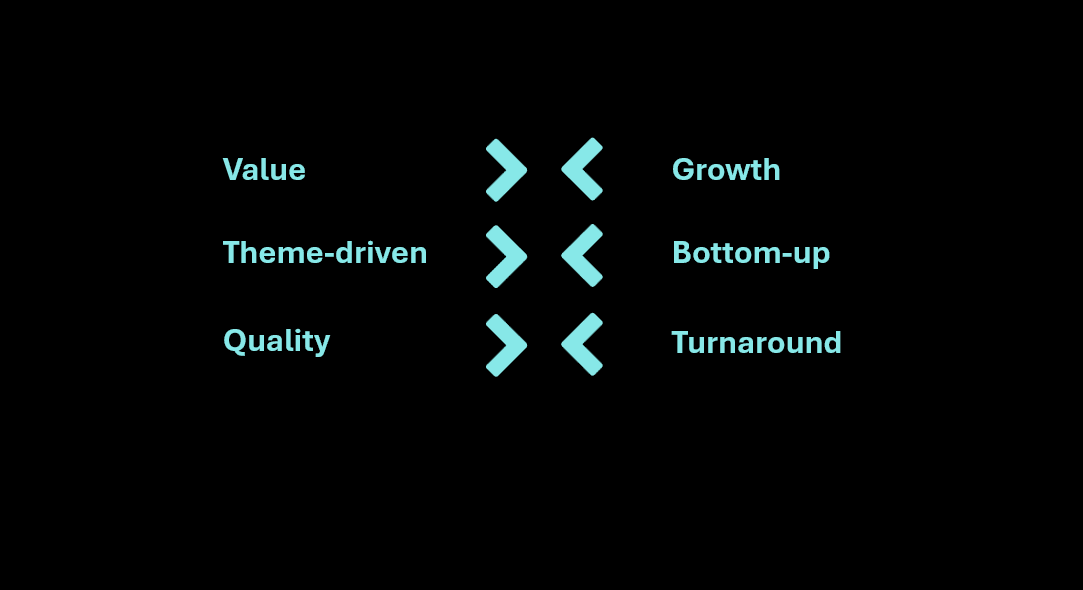
At the beginning of our journey building Distilla, one friend asked us whether our AI system will just give out the “right answer” to generate alpha and replace the hedge funds entirely. Our answer is NO. Because we don’t think there is only one single right answer.
The beauty of investment, both an art and a science,.is in the diversity and in the debates - some make money from consensus (momentum) and some make their career from contrarian bets. This is why all stocks have buyers and sellers. Many strategies can lead to successful outcomes, and we decided to design Distilla with “framework” as a center concept to enable all types of fundamental investors to get successful.
So what do we mean by framework? What are the successful frameworks?
Successful Fundamental Frameworks
When we say “framework”, we mean the process and criteria to guide investment assessment. Within fundamental investing, we have seen many types of framework working well, throughout our career and among our users. Below are a few:
High quality: “the #1 company in the industry will likely continue performing well in the future. And I’d rather pay a bit more for the top company than a lower price for an inferior asset.” I still remember this as one of the principles discussed among IC members at one of my prior jobs. The firm’s strategy focuses on longer term holding with strong focus on downside risks.
Deep value: on the other hand, another fund is known to only pay <10 EBITDAx and scrutinize free cash flow very closely, to make sure they have an extreme cushion on valuation. Because of this criteria, they made their fame in picking and making good profit from distressed / turn-around / legacy businesses.
High growth: another fund I worked for subscribes to the philosophy that growth will be the primary driver for value appreciation. Inevitably, the analyses tend to focus on verifying the growth trajectory and the ceiling. The assessment on valuations tends to be growth-adjusted.
Controversial situations: one VC told me the best deals he has done were all the ones that saw the most heated debates among IC members. This is also true for public market investing. Some investors we know spend a tremendous amount of time focusing on very deep analyses on the stocks that have the most diverging views / outcomes. When they have strong convictions, they bet on these and often see big alpha, if successful. Many landmark wins we know have this characteristic, and we also know funds that adopt this as their core strategy and consistently perform well..
Thematic bets: some funds with sector expertise can discover and execute thematic bets consistently over many years, whether it’s industrial cycles, tech waves (AI, SaaS, etc.), or financials (policy and macro cycles). These investors tend to have strong insights to enter and exit at the right time, as the theme starts, spreads and fully materializes over time.
Undercovered mid/small cap: while it’s well known that mega-cap stocks (e.g. Mag 7) dominate the market and generate most of the returns over the recent years, we also know a few smaller funds that have made consistent and stellar returns focusing only on mid / small caps. They are undercovered, not possible to trade for large funds, and therefore can still present arbitrage opportunities. To make this framework work, a lot of work has to be done to screen out these hidden gems and to overcome the lack of coverage.
The list can continue for very long. It’s a bit arbitrary for us to give these frameworks a name, as they are really just “bags of tricks”, as Charlie Munger described it. I have seen companies all in the “thematic” space, but all with a little bit different flavors - some take a basket approach and focus on timing, some look for 2nd or even 3rd derivatives, etc. For “controversial” ones, we know some that lean on study of history to get comfort while others exhaust expert calls.
The thing in common is that they are consistent. They believe in their framework and perfect the practice over many years. To certain extent, those frameworks they embrace are part of their identities, and extensions of their own personalities.
Observations on Frameworks
From these successful investors, we have a few interesting observations:
Frameworks don’t mix.
By nature, different frameworks may lead to different decisions on a given opportunity to evaluate. For example, the fund known for investing into high-quality leaders would not be comfortable with paying high valuation on a high-growth company. First, a fund well-versed in evaluating “high-quality businesses with lower risks” tends to focus more diligence on history and can get more definitive answers on how to linearly extrapolate future. This does not work when reviewing a high-growth company in a new / emerging industry. Secondly, the growth-adjusted valuation multiples are usually foreign to an investor focusing on LTM multiples and at max one-year forward projections. I looked at the same investment opportunities at two renowned funds, and indeed the conclusions are as polarized as you can imagine.
Because of this, any investor who wants to adopt multiple frameworks to capture more different types of alphas tend to face tremendous challenges. This is why multi-strategy teams tend to have different leaders overseeing different strategies. I’ve seen a few failures where successful teams of investors try to add a few more new strategies and fail to adapt.
It may not always work!
Many of our friends in Asia have faced this soul-searching question over the last 5 years - does fundamental investing work in the China / HK market?
Chinese stocks listed in Hong Kong were deemed “uninvestable” over 2022-24, followed by sudden jumps in late 2024 / early 2025, which made HSI the best performing index recently. Some argued that, for the entirety of the past 5 years, the stock market in Hong Kong / China has been more dominated by geopolitics, China regulations, and liquidity / sentiment, instead of fundamentals.
Indeed, one framework may work well for a particular period of time or a market, but no others. This is why some of the greatest investors and funds had to suffer many years of underperformance in their career. The US stock market experienced a flip between the first decade and the second decade of 2000s. While growth funds were the darling during 2018-2022, now many look back at that period and regret deploying so much capital chasing high-growth companies at crazy valuation. Don’t forget, the value investors underperformed and suffered during that time, and the growth investors were the envy of the day.
So do we switch framework from time to time?
If it’s hard to adopt multiple frameworks at the same time, and one framework does not work all the time, should we be flexible and change frameworks from time to time?
This has been one of the top topics in our conversations with the investor community. Some purests believe that one needs to stay true to one school of thought, while others believe a good investor needs to adapt, be flexible and always open to new rules of the game.
Both approaches may be plausible and we have seen people taking real actions to back up their decisions. One fundamental L/S fund analyst quit and switched career to quant. A few others switched from deep fundamental research to leaning more on reading charts and figuring out what other funds are trying to do. Some others chose to allocate away from the Hong Kong market and allocate more to Japan and US where their frameworks are supposed to continue working. A few funds stayed true to their frameworks and picked up undervalued HK stocks when the entire world was turning away. They had doubts and had to endure a long period of sideway trading, but their early positions helped them ride the tide when it came back a few months ago.
Our belief is that, no matter how AI disrupts the world, diversity in frameworks will continue for investing. In fact, being crystal clear, differentiated and disciplined about each one’s own frameworks will become even more important as the game shifts from battle on diligence and information access to battle of thinking depth and framework.
We at Distilla aim to enable this transition, by (a) letting AI take care of all info collection & synthesis to let you focus on the most important things, (b) codifying the common-denominator part of fundamental investing framework into our system, such as industry knowledge template, analytical flows to understand business, industry, valuation and drivers, and (c) enabling users to screen and assess based on your own unique framework. We are halfway towards this goal. If you are an investor who shares this vision of a framework-driven future, drop us a note to join our beta and help us build the next generation of investment tools.
About Distilla
Distilla is an AI-powered insight generation engine, made by veteran investors, for serious fundamental investors. Designed as a full-cycle acceleration platform, Distilla’s agents and AI contents help make investors more efficient in ideation, initiation, analyses, thesis iteration and tracking. Powered by a proprietary knowledge base and analytical frameworks codified from the best investors, Distilla delivers higher quality outputs and better insights. Get in touch with us at info@distilla.ai.